The Rewrite Tax: Why Cross-Posting Fails & How to Transform 1 Idea Across 15 Channels
By Mozeq · 5 min read · November 5, 2026
If you publish content regularly, you are probably paying a quiet tax.
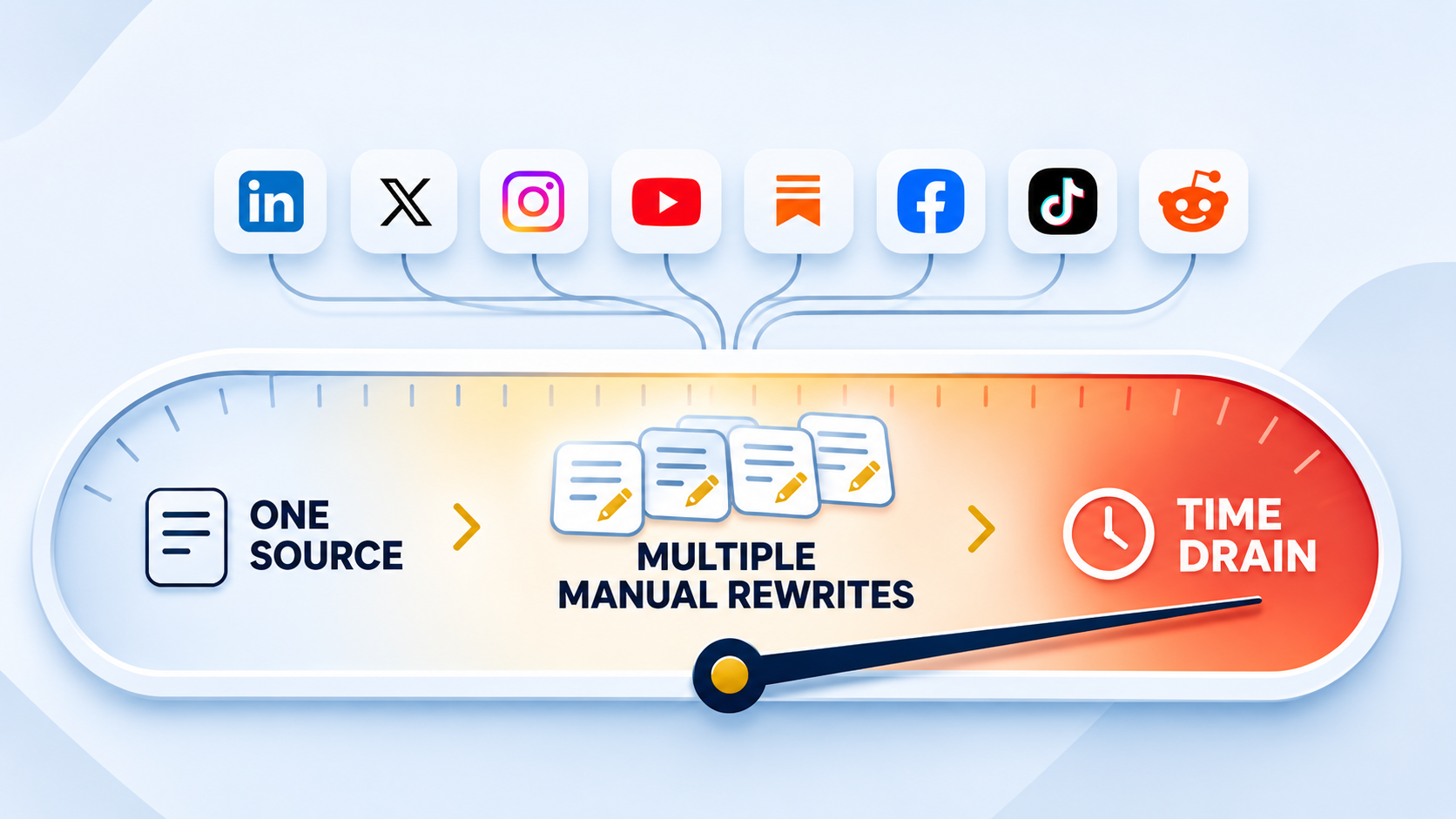
It is not an advertising tax, or an algorithm penalty. It is the Rewrite Tax: the punishing, repetitive hours you spend taking one strong idea and manually rewriting it into different shapes for LinkedIn, X, Substack, YouTube Shorts, Instagram and other digital channels.
Most founders, creators, and marketers know the risk of relying on a single channel. Relying exclusively on one platform leaves your reach vulnerable to sudden algorithm shifts and policy updates.
Yet when creators try to expand to multiple channels, they almost always hit the same wall. They either:
- Lazy cross-post: Copy and paste the exact same text everywhere, hoping for maximum reach, visibility and engagement.
- Burn out: Spend 8 to 12 hours every week manually rewriting the same core thoughts from scratch.
- Hire an agency: Pay $2,500 to $5,000 every month for outsourced repurposing teams that can add cost, coordination, and distance from your original voice.
There is a fundamentally better way: Content Transformation.
1. Why "Lazy Cross-Posting" Destroys Reach
One of the fastest ways to weaken organic reach on any modern social platform is to treat every network as an identical broadcast tower.
Each platform has its own cultural and structural norms:
- LinkedIn content often works well with structured professional narratives, clean line breaks, practical insights, and clear business takeaways.
- X (formerly Twitter) lives on concise hooks, rapid pacing, punchy declarative statements, and tight, threadable ideas.
- Newsletters and Feature Articles require narrative depth, editorial pacing, clear section architecture, and sustained substance.
- Short-form Video Scripts (Reels / YouTube Shorts) benefit from a fast hook, conversational pacing, and clear visual direction.
When an audience on X sees an obvious LinkedIn copy-paste, they may scroll right past it. When LinkedIn readers encounter a fragmented single-sentence thread with no narrative context, engagement can stall.
The platforms do not reject your idea. They reject the wrong container.
2. The 8–12 Hour Rewrite Trap
Once creators realize that cross-posting fails, they usually decide to rewrite everything by hand.
For anyone producing content across several channels, manual formatting and adaptation can consume a significant amount of time.
For anyone producing content weekly, the cycle is brutally predictable:
- Monday: You spend 3 to 4 hours researching, drafting, and refining a high-quality article or essay.
- Tuesday: You spend another hour turning it into a LinkedIn post.
- Wednesday: You spend an hour condensing it into an X thread.
- Thursday: You spend two hours drafting an email newsletter edition.
- Friday: You attempt to script a short-form video concept, get exhausted, and give up.
By Friday afternoon, that can add up to 8 to 12 hours in a weekly cycle — an entire working day drained just reformatting work you already created.
That is the Rewrite Tax. It turns high-leverage thinkers into low-leverage typists.
3. Repurposing vs. Transformation: The Critical Difference
To solve this bottleneck, it helps to understand what happens when content travels across platforms:
- Repurposing is the broader objective: taking one valuable source and reusing its ideas across multiple outputs.
- Transformation is how you do it effectively: reshaping that source for each destination by adapting its structure, style, depth and presentation. Your selected goal, audience, tone and call-to-action help guide that transformation.
Repurposing without transformation produces lazy cross-posting: the same message pushed into channels with different expectations.
True transformation preserves the substance while changing how it is expressed for the destination.
Language adds another dimension: Mozeq supports 25 output languages, allowing transformed content to be generated in the language you select.
4. The Mozeq Framework: 1 Input, 4 Steps, 15 Channels
We built Mozeq to eliminate the Rewrite Tax once and for all.
Mozeq is not an unguided chatbot where you have to engineer 50-line prompts every morning. It is a purpose-built Content Repurposing & Transformation workspace designed around a four-step pipeline:
Step 1 — Add Your Content
Type or paste content, upload a supported file, or enter a URL. Your original source remains the anchor.
Step 2 — Choose Channels & Language
Choose from 15 supported channels – including Newsletter, Feature Article, LinkedIn Post, X Thread, Reels/YouTube Shorts Script, and more. The number of channels available depends on the plan you select. Select your output language from a choice of up to 25 currently supported languages.
Step 3 — Set Your Preferences (Optional)
Select your specific Content Goal, define your intended Audience, choose the Tone, and select the appropriate Call to Action.
Step 4 — Generate, Review & Use
Generate channel-ready outputs adapted in structure, style and depth. Review them, refine where needed, then use them.
You do not write 15 times. You write once with depth and clarity, then transform that effort into a complete multi-channel content workflow.
Stop Paying the Rewrite Tax
Multi-channel content creation should not require burnout, and multi-channel growth should not require a dedicated agency budget.
If you have insights worth sharing, your time is best spent developing those ideas—not reformatting bullet points for the fourth time this week.
Ready to see it in action?
Transform your first piece across your chosen channels. Plans start at just $5/month.
Start your 5-Day Free Trial on Mozeq